Quantum Computing

Figure 1 · section 0.5

Quantum
Computing.

One qubit in an even superposition, with a phase written between its two terms. Measured here, both outcomes are one half for every φ.

A second Hadamard brings the two amplitudes into the same outcome, so that they add or cancel: p(0) = cos²(φ / 2).

A run of shots estimates that probability. The gap to the exact value is what a finite run costs, and it closes as one over the square root of the shot count.
H · P(φ)p(0) = 0.500 for every φ
Quantum Computing · Figure 10%
7chapters
272scenes
31laboratories
120worked questions

The course

Seven chapters.

A student arrives believing that a quantum computer tries every answer at once, and every later idea is harder to read while that sentence is still believed. Each chapter is either a way of writing a state down, a way of acting on it, or a way of arranging the one measurement that ends the computation.

  1. 0

    The frame of the course

    What the machine is for, how large the state really is, and the one interference experiment the rest of the course generalises.

  2. 1

    The mathematics of quantum states

    Columns, inner products and what they conjugate; amplitude against phase; projectors, the tensor product, and where the exponential comes from.

  3. 2

    States, measurement and dynamics

    The Born rule, what a reading leaves behind, the Pauli algebra, evolution as an exponential, and what a finite run of shots is worth.

  4. 3

    Mixed states and entanglement

    The density operator and the two situations no state vector describes; channels, relaxation and dephasing; the partial trace; Bell states and CHSH.

  5. 4

    The Bloch sphere and quantum gates

    One qubit drawn, and every operation on it as a motion of that drawing. The half angle, the gate set, and the two-qubit ordering that fails silently.

  6. 5

    Circuits and protocols

    Depth against gate count, shots and error bars, what a compiler does — then teleportation and Grover search, worked end to end.

  7. 6

    Quantum algorithms

    One mechanism, phase kickback, and the four algorithms built from it: through the Fourier transform and phase estimation to order finding and factoring.

On paper

Three documents.

Typeset from the same sources as the course, as PDFs.

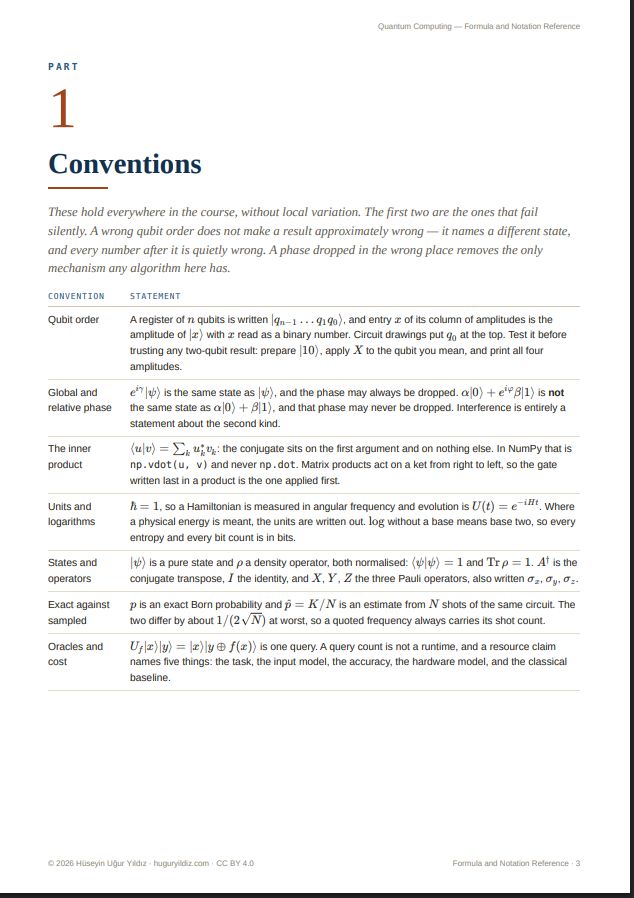
Two conventions decide every number here, and mixing them is silent rather than loud: a register is written |qn−1 … q1q0⟩, so entry x of the column is the amplitude of the basis state x read as a binary number; and a phase on the whole state may always be dropped while a phase between two terms may never be, because that is what interference is made of.